Custom systems for the workflows your business actually has.
Custom ERPs, internal SaaS, role-based portals, and integration platforms — built end to end on AWS for operations-grade reliability. The whole platform from one team, not seven products glued together.
Three shapes of platform work we keep being asked for
Different starting points, same approach — model the business first, then build the platform that fits.
Off-the-shelf SaaS doesn't model what you actually do.
Manufacturers, co-packers, logistics operators, specialised services teams — your workflows have rules that no horizontal SaaS will ever fit. We model your process first, then build the platform that fits it.
- Discovery on the floor, not in the IDE — we map the actual workflow before architecting.
- Production scheduling, inventory, quality, and audit trails as first-class concerns.
- Mobile companion apps for floor and field teams, designed for gloves-on use.
Replace the patchwork with one platform you can audit.
You're running operations on a stack of spreadsheets, three SaaS tools, and a Slack channel. It worked at 10 staff; it's leaking at 50. We replace the patchwork with one platform that fits the next decade of growth.
- Unified data model across the workflows currently split across tools.
- Migration plan that doesn't require a 12-month freeze — phased cutovers.
- Reports and dashboards built on the underlying data, not bolted on after.
Role-aware portals for Operations, Finance, and IT.
Your platform has three audiences with different needs — operations needs speed, finance needs auditability, IT needs control. We build role-aware portals that give each role the views and permissions their job actually requires.
- Separate portals per role, sharing the same backend and audit trail.
- Permissions scoped to the workflow, not just the data.
- Audit trails and compliance checkpoints designed in, not retrofitted.
One platform, every workflow
Built as a single coherent platform, not seven products glued together. Roles, data, and audit trails flow through everything.
Custom ERP and operations platforms
Production scheduling, multi-warehouse inventory, quality management, and the unglamorous workflow plumbing that actually runs the business.
Role-based portals
Separate, role-aware portals for Operations, Finance, IT, and external partners — each with views and permissions tuned to their work.
EDI and partner integrations
EDI (X12) with retailers, REST APIs with suppliers and partners, batch and event-driven integration patterns — audit-clean by design.
Audit trails and compliance
Every state change logged, every quality check captured, every approval flow traced — audits (internal and external) pass cleanly.
Mobile companion apps
Shop-floor, field, and warehouse mobile apps for teams that work in gloves and aren't sitting at a desk. Built native or cross-platform.
Reporting and dashboards
KPI dashboards built on the underlying operations data — not a separate BI stack pretending to be the source of truth.
Discover. Design. Build. Ship.
The same four-phase model — adapted to platform work's particular hazards: scope creep, integration surprise, and the gap between what stakeholders say they need and what the workflow actually requires.
Discover
Walk the floor, sit with each role, map the workflow as it actually runs. The platform has to fit the business, not the other way around.
- Workflow map
- Role / portal plan
- Phased delivery roadmap
Design
Data model, system architecture, role and permission design, integration design. Written down, reviewed with the team — not assumed.
- Data model
- System architecture (AWS)
- Role and integration spec
Build
Senior engineers ship in two-week sprints. Each module hits production behind a feature flag — no week-long deploys, no big-bang cutover.
- Production-grade code
- CI/CD via GitHub Actions
- Phased rollout plan
Ship
Phased migration off legacy tools. Audits pass cleanly. Mobile apps land on the floor. We don't hand over and disappear.
- Monitoring & alerting
- Runbooks
- Audit-ready documentation
Boring infrastructure, on purpose
Every choice is one operators and auditors can scrutinize, scale, and replace independently. No esoteric stack, no lock-in to one vendor.
AWS ECS + RDS
Auto-scaling containers on ECS, PostgreSQL on RDS with point-in-time recovery, ALB in front, VPC with least-privilege IAM.
Node.js + TypeScript
Type-safe backend with shared types across portals and integrations — the kind of code the next engineer can hold in their head.
React + Next.js
Role-aware portals with server-rendered UX where it matters, client-side interactivity where it pays off.
GitHub Actions CI/CD
Boring, reproducible, audit-friendly deployments. The kind of pipeline that doesn't need a dedicated DevOps engineer to babysit.
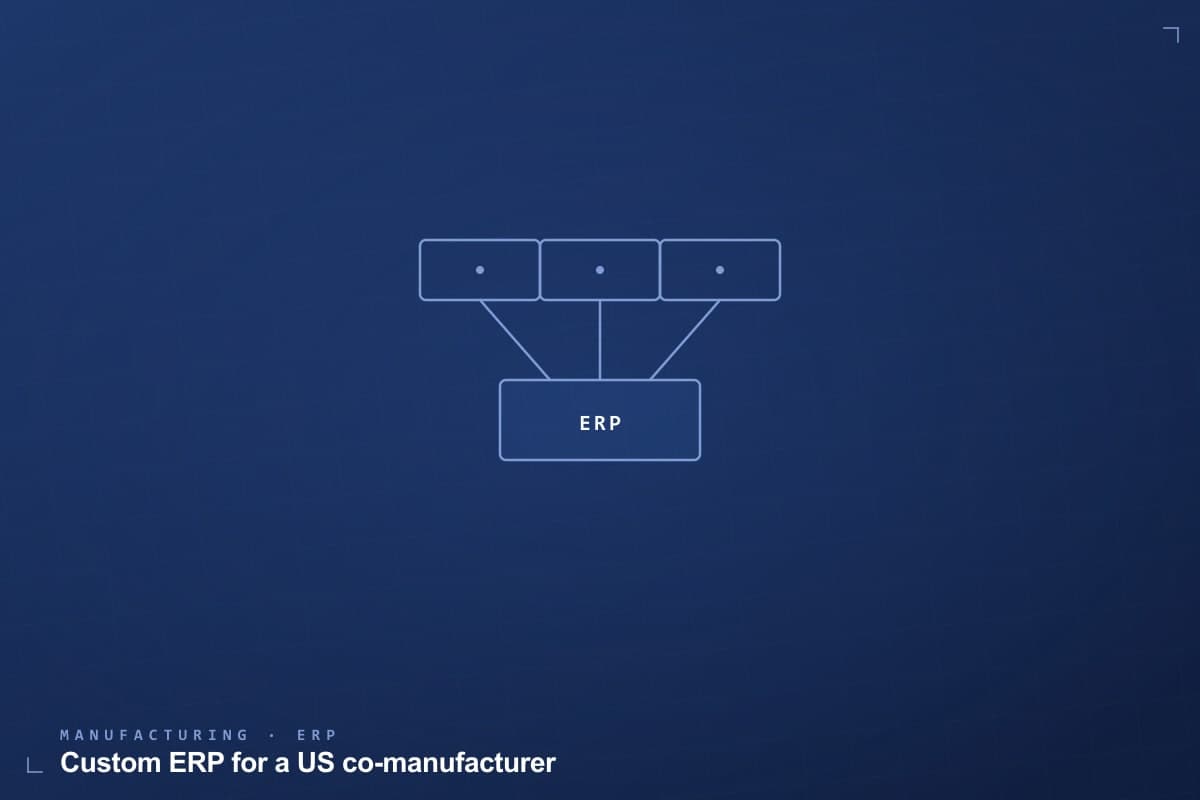
Custom ERP for a US co-manufacturer serving major retailers.
End-to-end ERP from zero — production scheduling, multi-warehouse inventory, retailer EDI compliance, role-based portals for Operations, Finance, and IT, and a mobile shop-floor app. All on AWS with engineering rigor that holds up under retailer audits.
Got a platform you need built right the first time?
Discovery calls are for mapping the workflow honestly. Estimates are for when the scope is clear and you need numbers to bring to the table.